(010) 303-300

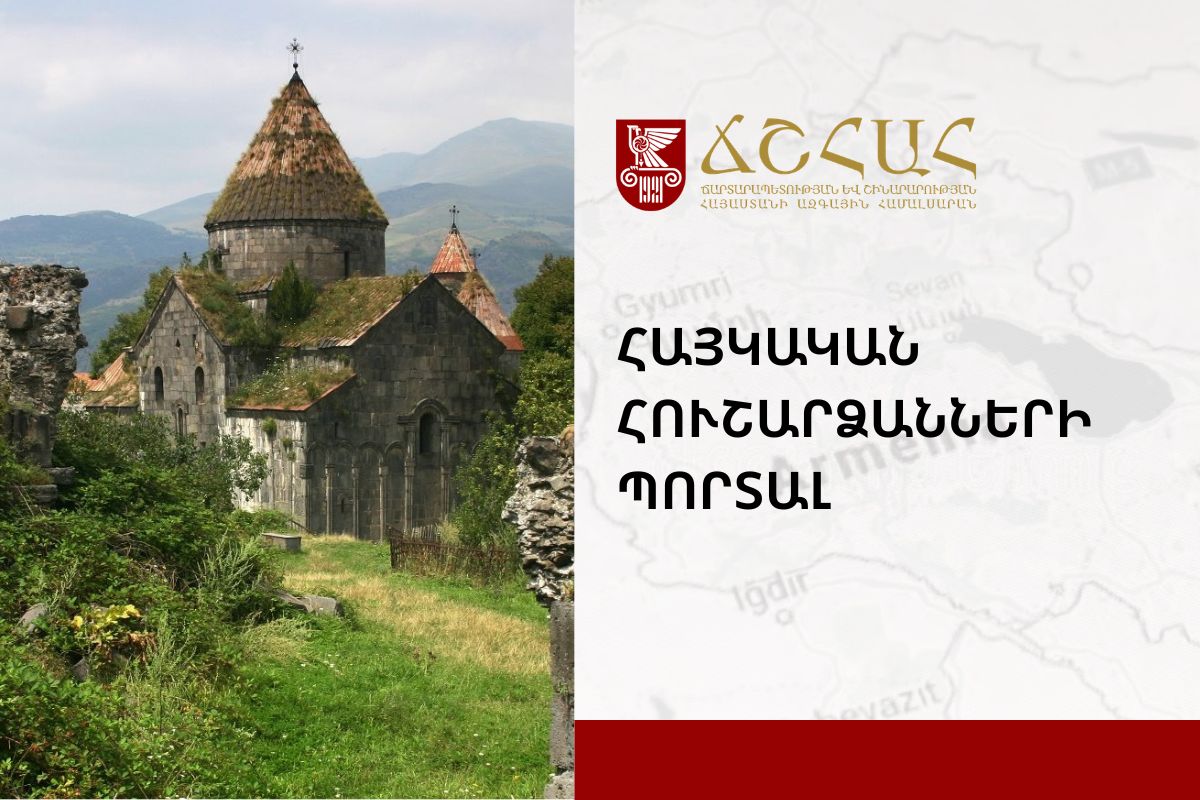
NUACA, with the support of the Armenian Cultural Heritage Center in Valence, the French Republic, has started the work on the implementation of the Armenian Monument Portal. The project aims to create an interactive map, where all the Armenian monuments of the Armenian Plateau will be presented on one platform, with the necessary scientific and historical information. The map will be a research, educational and accessible tool aimed at the preservation and dissemination of the Armenian architectural heritage.
The purpose of the development of the Armenian Monument Portal is to popularize the Armenian architectural heritage, three-dimensional modeling of architectural monuments with the introduction of the latest information technologies, as well as the development of theoretical, three-dimensional reconstruction projects based on three-dimensional models of monuments. The portal creates a comprehensive database of architectural monuments according to the developed format, which will be a reliable source for students and researchers studying Armenian architectural heritage, especially within the framework of the graduate course “Digital Technologies in the Field of Architectural Heritage”. The portal will also include educational games, films using three-dimensional models of Armenian architectural monuments for schoolchildren, students and all those interested.
Currently, various computer programs are being developed and used in the republic, the purpose of which is mainly to familiarize tourists with the cultural heritage of Armenia. The Armenian Monument Portal will have a number of advantages over existing similar programs: in particular, the developed three-dimensional models will be of maximum accuracy, three-dimensional models of theoretical reconstruction will also be presented, the information loaded in the scientific section will be purely from scientific periodicals, monographs and other scientifically reliable professional sources, and the work will also be carried out with the participation of students.
Portal structure and brief content. Currently, an Armenian-language map is being created, which is a computer information program, where when you enter you can see many active points connected to a virtual map, which show the location of Armenian monuments. When you click on any point, a window will open where you will find a description of the location of the given monument, a historical overview, photos, measurements, a three-dimensional model, in which you can “walk” and get acquainted with the architecture of the monument, lithographs, ornaments, a list of literature, see three-dimensional images.
Public information will be open to all users, especially for the tourism field. The portal, in addition to the public section, will also have scientific information for researchers. Unlike the previous one, the information obtained from this page is of a purely scientific nature. The posted graphic materials and information are applicable for use in scientific research and student work. It is envisaged to periodically update the page with new scientific articles, reconstruction projects.
The portal will also include an archive of student works, where reconstructions of architectural monuments and other works related to them over the years will be collected: baseline, documentary, photographic materials. With the recommendation of the portal’s scientific council, some student works can also be uploaded to the scientific information section, preserving the copyright of the student and their supervisor.
The educational games and films section presents educational three-dimensional games, activities and mental exercises. Based on the already developed three-dimensional models, users can not only assemble the proposed monument from individual architectural and construction elements, but also receive etymological, explanatory information after the completion of any main part of the structure. For example, what is a church dome, a drum or a spire. Downloaded films and animations will comment on the history of Armenian and world architecture, theoretical foundations, parallels and influences.
The development of the Armenian Monument Portal, especially at NUACA, has a number of advantages: most of the architects who restore architectural monuments are currently included in NUACA academic staff, theorists of Armenian architecture are also mainly lecturers at our University. NUACA is the only university where architects who study and restore architectural heritage are trained and the “Restoration of Architectural Heritage” graduate academic programme is operating, the University has laboratories on the basis of whose material base the programme will be developed.
The idea of such a three-dimensional map was developed at the University many years ago, but it is now becoming a reality with the support of the Armenian Cultural Heritage Center in Valence, which, through its initiative, will make a significant contribution to the documentation and popularization of Armenian monuments.